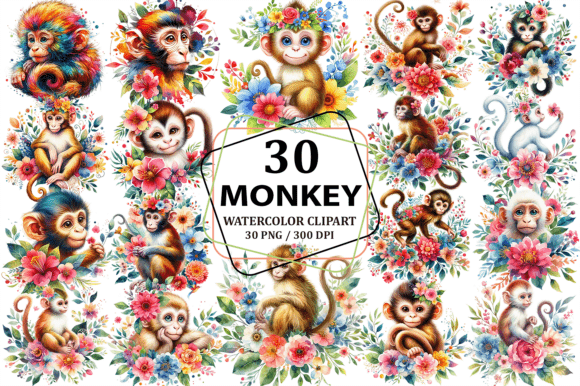
Watercolor Quirky Monkey Clipart
Some design assets just click. You open the file, and suddenly a dozen project ideas start forming before you even finish the download. That is the kind of energy Watercolor Quirky Monkey Clipart brings to the table. It is playful without feeling childish, artistic without being fussy, and versatile enough to work across both digital and print applications. If you have been hunting for something that adds warmth and personality without sacrificing professional polish, this collection deserves a close look.
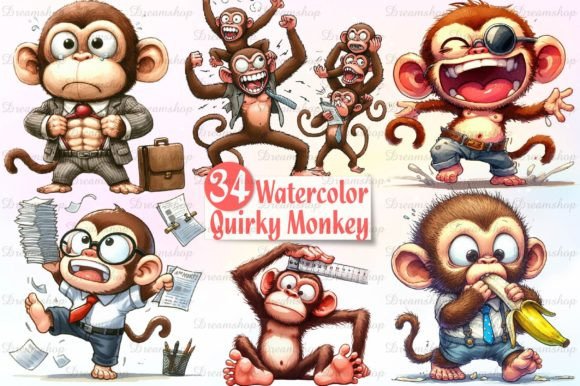
The visual personality here is unmistakable. These are not stiff, vector-flat monkeys with generic expressions. Each illustration carries a hand-painted quality—soft washes of color, subtle texture from the watercolor medium, and a loose, expressive line that feels organic. The quirky angle comes through in the poses, the facial expressions, and the little details like tilted heads, oversized ears, or mischievous grins. It feels less like a stock asset and more like something an actual artist painted in a studio, which is precisely the point. That handmade aesthetic builds instant trust and approachability in any design context.
Visual characteristics that set this clipart apart
The watercolor technique gives every monkey a natural softness. Edges bleed gently rather than sitting crisp and artificial. Color palettes tend toward warm, earthy tones—burnt sienna, ochre, deep brown, and soft cream—with occasional pops of brighter color for contrast. This makes the clipart feel grounded and organic rather than cartoonish. The quirkiness comes from the personality injections: a monkey dangling upside down, another wearing a tiny crown, one mid-sneeze with closed eyes. These are not random novelty drawings. Each one reads as a genuine character with its own mood.
From a design standpoint, this matters because Watercolor Quirky Monkey Clipart fills a specific gap. So much of the clipart market leans either hyper-realistic (great for scientific content but stiff for branding) or flat-vector cartoon (clean but often cold). This collection sits right in the middle—it has the warmth of traditional art and the clarity needed for commercial use. The textures also give it a natural depth that photographs well and scans beautifully in print.
Where this clipart works best across real projects
One of the biggest mistakes designers and small business owners make is buying clipart that only works in one context. You want assets that stretch across your needs. Here is where Watercolor Quirky Monkey Clipart genuinely delivers.
- Brand identity and logo design. A monkey character with watercolor texture can anchor a brand that wants to feel friendly, approachable, and creative. Think children's boutiques, organic food brands, eco-tourism companies, or artisanal product lines. The soft watercolor look signals handmade quality and care.
- Packaging design. Product labels, gift tags, and small-batch packaging benefit from the tactile look. A monkey peeking out from the corner of a tea box or snack wrapper adds charm without overwhelming the product information.
- Social media graphics. Instagram posts, Pinterest pins, and Facebook banners need to stop the scroll. The textured, colorful nature of watercolor art stands out in a feed full of flat graphics and photos. Use a monkey character to introduce a post, highlight a promotion, or add personality to an otherwise text-heavy announcement.
- Editorial and publishing. Blog headers, e-book covers, printable planners, and children's content all gain warmth from these illustrations. The watercolor aesthetic fits especially well with lifestyle, parenting, education, and wellness niches.
- Web design. Hero sections, call-to-action buttons, and illustration-heavy landing pages can use Watercolor Quirky Monkey Clipart as accent elements. Because the artwork has texture, it pairs well with modern serif and sans serif typefaces without feeling mismatched.
- Print-on-demand and merchandise. T-shirts, tote bags, mugs, stationery, and wall art all benefit from the hand-painted look. The quirky expressions give products a conversation-starting quality that standard clipart lacks.
How this clipart influences brand perception and audience engagement
Design choices send signals. A cold, corporate sans serif paired with generic icons tells people you are efficient and maybe a little distant. A warm, textured illustration paired with thoughtful typography says you are creative, approachable, and authentic. Watercolor Quirky Monkey Clipart works as a trust-building design asset because it visually communicates that a human being was involved in the process. In an era of AI-generated everything, that human touch actually matters more than ever for audience engagement.
The monkey itself is a universally recognizable animal, which reduces cognitive load. Viewers do not have to decode what they are looking at. Combined with the quirky expressions, the clipart creates an emotional micro-moment—someone smiles, tilts their head, or feels a small sense of delight. That split-second emotional response is the foundation of brand recall. You remember how something made you feel, not the specific product details. Using this clipart strategically in logo design, packaging, or social media graphics can significantly boost recognition and positive association over time.
From a visual hierarchy perspective, these illustrations function best as accent or hero elements rather than background textures. Because watercolor has variable opacity and soft edges, putting text directly over the art can reduce readability. Smart positioning means letting the monkey sit to one side of your headline or inside a circular frame, with ample negative space around it. Pair it with a clean sans serif font for a modern contrast, or a warm script font if you want to double down on the handcrafted feel. The clipart gives you a natural color palette to pull from for your type colors, which creates instant visual consistency across a brand identity.
Practical guidance for choosing and using this clipart
Before you purchase Watercolor Quirky Monkey Clipart, take a moment to evaluate project fit. Ask yourself three questions. First, does the tone of the clipart match your brand voice? If you run a financial consulting firm, a playful monkey may confuse your audience. If you run a children's book publishing house or a natural skincare line for young families, it fits naturally. Second, review the included styles and file formats. A good commercial clipart set should offer transparent PNG files with high resolution (300 DPI for print) and ideally vector or layered options for scaling. Check whether you get variations—different poses, expressions, or orientations—so you are not stuck with one look across an entire campaign.
Third, test your font pairings early. Because Watercolor Quirky Monkey Clipart has organic, irregular edges, pairing it with a rigid geometric typeface can feel disjointed. Instead, try a rounded sans serif like a friendly grotesque, or a soft handwritten font that echoes the brush strokes. If you need a more formal look for body copy, use a clean serif font that brings editorial credibility while the monkey illustration keeps the overall tone warm. Always create a mockup before finalizing. The interaction between type, image, and layout matters more than any single asset.
Licensing is another critical consideration. If you are a small business owner or entrepreneur using the clipart for commercial projects—packaging, products, marketing materials—confirm that the license covers commercial use without restrictions on print runs or distribution. Some clipart sets limit usage to personal projects or cap the number of products you can produce. Read the terms carefully. A premium commercial license is almost always worth the extra cost if you plan to use the asset across multiple touchpoints.
For designers and content creators working with clients, this clipart can be a real time-saver. Instead of commissioning custom watercolor illustrations for every project, you can pull from a well-curated set that already has cohesive style and color harmony. Just be smart about mixing it with other design assets. If you use the monkey clipart, avoid adding other illustrations with different rendering styles—stick to one watercolor set so the visual language stays consistent. Use texture overlays sparingly. Let the watercolor art breathe without competing filters or effects.
Final design observations and recommendations
Watercolor Quirky Monkey Clipart works because it brings something increasingly rare in the digital design world: a genuine sense of play. It is not trying to be everything to everyone. It knows its lane—friendly, artistic, slightly mischievous—and it stays there. For bloggers, crafters, publishers, and small brand owners who want to inject personality into their work without reinventing the wheel every time, this collection delivers real-world value. Use it strategically, pair it thoughtfully with modern typography, and let the imperfections of the watercolor medium do the heavy lifting on authenticity. Your audience will feel the difference.